THE LI WOOD CARVERS SHOW


Saturday, February 16, 2013

I decided to go to the master, Leonardo da Vinci, and get some TIPS from the great man!

Issue 40 Holiday 01

Proportion tricks

by Lets Talk Carving with Susan Alexander


No matter what you carve – proportions count. When a carving is unsuccessful, we know that something is wrong, but often have a difficult time deciding what is wrong. I’ve always marveled at how a great instructor or educator can quickly pinpoint exactly what needs to be corrected in a carving. It doesn’t matter whether it’s a caricature, stylistic, or realistic carving a good carver understands proportions.
I’m often asked by civilians (non-carvers), “You carve? …wood? … really? Uh … why?” Translation: “Why would you want to play with wood, sharp knives, band saws, sharpening systems, air filters, drill presses and sanders?”
I used to respond by saying, “Because I want to.” But, this last year, I took their question seriously and asked myself why I was carving – did I have a goal beyond the simple joy it brought me?
I discovered what I truly desired was to be able to successfully carve any subject that thrilled me (no matter how many years it might take.) I love wood and I love the challenge.
Issue 40 Holiday 01I bring this up, in conjunction with proportions, because since realizing my goal I found that I’m reading books in a different manner than I had previously read them.
I thought the carvings and sculptures in these books were so far beyond me that they had nothing to do with my carving efforts. That isn’t true. We can learn from everyone, especially those great artists who left us their notes.
Leonardo da Vinci left notes, diaries, and drawings. Let’s discover how we can use them.

Sunday, January 20, 2013

Working With Reclaimed Woods

Saints carved from reclaimed wood and hand-painted by artisans in Guatemala.

Working With Reclaimed Woods
Old barn boards, crates and pallets (often free for the taking) are all examples of valuable lumber that often gets relegated to the garbage pile. Woodworker Charles Mak, who recently made a jigsaw-puzzle frame out of pallet boards, explains how to use reclaimed wood in your projects. Read more...

Monday, January 7, 2013

Carve Hobo Nickels


How to Make Hobo Nickels

Click to view enlargment.
The United States minted buffalo nickels from 1913 through 1938.
During this time period and beyond, folk artists used hand tools to
alter the distinguished Indian head on the front of these coins.
Famous hobo nickels show the Indian's head accentuated with
details such as beards and hats or fully transformed into a famous
personality or comical character. Some artists would even transform
the buffalo on the back of the nickel into a different animal.
With a few engraving tools and a steady hand, you can alter
your own buffalo nickels or use your imagination to carve modern coins.
Difficulty:
 
Moderately Easy

Instructions


Things You'll Need


  • Fine-tipped marker
  • Hand engraving tool with nail and carbide tip
  • Craft knife
  • Hammer
  • Nail
  • Metal polish
  • Polishing cloth
    • 1
      Draw your desired shape and details on the surface of the nickel,
      using a fine-tipped marker. Try to work with the details and contours
      of the original nickel to make your finished nickel look authentic.
    • 2
      Smooth and carve away away large areas of metal with your hand
      engraving tool and a carbide tip.
    • 3
      Engrave fine lines on the metal surface with the hand engraving
      tool and a nail tip or a craft knife.
    • 4
      Hammer a nail into the coin to create stippling or small, rough
      details such as pockmarks.
    • 5
      Polish the finished nickel with metal polish and a polishing cloth.

Resources

Wednesday, January 2, 2013

A CENTURY OF WHITTLING – 1865 – 1965

a folk history by Donald K. Mertz – The WOOD BEE CARVER  http://woodbeecarver.com/


Wood carving is perhaps one of the oldest forms of art that originated the first time a human shaped in a decorative manner a piece of wood with a sharp stone. Whittling developed when sharpened metal knives were used to carve a hand held piece of wood making Whittling one of the earliest forms of carving.
In the United States Whittling was most prevalent in the century between 1865 and 1965. The Civil War brought together men from different states and territories in a melting pot kind of gathering. Sitting around the campsite the soldiers would relax by talking, playing cards, writing letters and some would be whittling. The folding jack knife was common among the soldiers who, if one had a knife one was prone to whittle. Some soldiers who were more proficient at whittling would teach others to whittle walking sticks or canes, animals, human figures, spoons, smoking pipes and whimsies like wooden chains, ball in a cage, fans and puzzles. A soldier from Maine would teach a soldier from Ohio how to whittle a particular object. A soldier from Georgia would show a soldier from Tennessee how to whittle. This was repeated over and over in the melting pot of the casual school of whittling.

“Whittling”


The Yankee boy, before he’s sent to school,
Well knows the mysteries of that magic tool,
The pocket-knife. To that his wistful eye
Turns, while he hears his mother’s lullaby;
His hoarded cents he gladly gives to get it,
Then leaves no stone unturned till he can whet it;
And in the education of the lad
No little part that implement hath had.
His pocket-knife to the young whittler brings
A growing knowledge of material things.
Projectiles, music, and the sculptor’s art,
His chestnut whistle and his shingle dart,
His elder pop-gun with its hickory rod,
Its sharp explosion and rebounding wad,
His corn-stalk fiddle, and the deeper tone
That murmurs from his pumpkin-stalk trombone,
Conspire to teach the boy. To these succeed
His bow, his arrow of a feathered reed,
His wind-mill, raised the passing breeze to win,
His water-wheel, that turns upon a pin;
Or, if his father lives upon the shore,
You’ll see his ship, “beam ends upon the floor,”
Full rigged, with raking masts, and timbers stanch,
And waiting, near the wash-tub, for a launch.
Thus, by his genius and his jack-knife driven,
Ere long he’ll solve you any problem given;
Make any jim-crack, musical or mute,
A plow, a couch, an organ, or a flute;
Make you a locomotive or a clock,
Cut a canal, or build a floating-dock,
Or lead forth Beauty from a marble block—
Make any thing, in short, for sea or shore,
From a child’s rattle to a seventy-four;—
Make it, said I?—ay! when he undertakes it,
He’ll make the thing and the machine that makes it.
And when the thing is made—whether it be
To move on earth, in air, or on the sea;
Whether on water, o’er the waves to glide,
Or, upon land to roll, revolve, or slide;
Whether to whirl or jar, to strike or ring,
Whether it be a piston or a spring,
Wheel, pulley, tube sonorous, wood or brass,
The thing designed shall surely come to pass;
For, when his hand’s upon it, you may know
That there’s go in it, and he’ll make it go.
by John Pierpont

Thursday, December 27, 2012

Carvin' a Noggin

Dr. Terry M. Trier
 
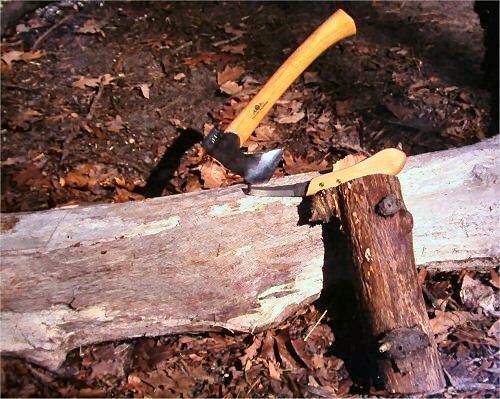
One of my favorite things to do in the woods (or anywhere, actually) is whittle. The nice thing about doing it in the woods is that you don't have to clean up the mess. On a backpacking trip to the dunes of Lake Michigan, I wanted to test out a few tools on a little whittling project. For this project, I used the Sawvivor, a Frost hoof knife, a Gransfors Bruks mini hatchet, and the Gerber Yari.I started with a block of wood (red oak) that I cut from a deadfall using the Sawvivor. This was pretty easy work for the little saw and an excellent tool for cutting saplings up to 5 or 6 inches.
 
noggin1.jpg (61672 bytes)

I used the GB mini to work the block into shape. I have to say I was totally impressed with this tool. It is a very precise wood carving tool and most of the initial shape was formed using the mini. It was a tremendous pleasure to cut with and the pile of chips lying around the noggin were easy as pie to create with the mini. This is a really wonderful tool.

Wednesday, December 12, 2012

Sculptures of Native American scenes made out of paper by Allen and Patty Eckman


 Scroll down for some fantastic art! 


Sculptures of Native American scenes made out of paper by Allen and Patty Eckman

 
Paper art of Native American indians made by Allen and Patty Eckman
These stunningly detailed sculptures may only be made from paper - but they are being snapped up by art fans for tens of thousands of pounds. The intricate creations depict Native American scenes and took up to 11 months to make using a specially formulated paper
Paper art of Native American indians made by Allen and Patty Eckman
Husband and wife team Allen and Patty Eckman put paper pulp into clay moulds and pressurize it to remove the water
Paper art of Native American indians made by Allen and Patty Eckman
The hard, lightweight pieces are then removed and the couple painstakingly add detailed finishing's with a wide range of tools
Paper art of Native American indians made by Allen and Patty Eckman
They have been making the creations since 1987 at their home studio, in South Dakota, America, and have racked up a whopping £3 million selling the works of art
Paper art of Native American indians made by Allen and Patty Eckman
The pieces depict traditional scenes from Native American history of Cherokees hunting and dancing
Paper art of Native American indians made by Allen and Patty Eckman
The most expensive piece is called Prairie Edge Powwow which sold for £47,000
Paper art of Native American indians made by Allen and Patty Eckman
Allen said: "We create Indians partly because my great, great grandmother was a Cherokee and my family on both sides admire the native Americans...
Paper art of Native American indians made by Allen and Patty Eckman
...I work on the men and animals and Patty does the women and children" explains Allen
Paper art of Native American indians made by Allen and Patty Eckman
"I enjoy most doing the detail. The paper really lends itself to unlimited detail. I'm really interested in the Indians' material, physical and spiritual culture and that whole period of our nation's history I find fascinating. From the western expansion, through the Civil War and beyond is of great interest to me."
Paper art of Native American indians made by Allen and Patty Eckman
Allen explained their technique: "It should not be confused with paper Mache. The two mediums are completely different. I call what we do 'cast paper sculpture'"
Paper art of Native American indians made by Allen and Patty Eckman
..."Some of them we create are life-size and some we scale down to 1/6 life-size"
Paper art of Native American indians made by Allen and Patty Eckman
"These sculptures are posed as standing nude figures and limited detailed animals with no ears, tails or hair"
Paper art of Native American indians made by Allen and Patty Eckman
"We transform them by sculpting on top of them - creating detail with soft and hard paper we make in various thicknesses and textures.
Paper art of Native American indians made by Allen and Patty Eckman
"We have really enjoyed the development of our fine art techniques over the years and have created a process that is worth sharing. There are many artists and sculptors who we believe will enjoy this medium as much as we have."


Paper art of Native American indians made by Allen and Patty Eckman
An Indian mother holding her baby is a favourite of many clients

Friday, December 7, 2012


Since we’ve temporarily lost the N Massapequa Community Center due to construction,  the meeting date is now the second Wednesday of the month. 
 Meetings will be held at the Special Activities Center in Eisenhower  Park.  We’ll return to Massapequa as soon as the project is completed.
Happy Holidays to all and a Happy and Healthy New Year! ... Ed Conti

Wednesday, December 5, 2012

December Meeting will not meet at the Massapequa Club House
The parking lot is being repaired.

Monday, November 19, 2012

December Meeting's

Bamfords Garage's Avatar
The next club meeting is set for Tuesday December 11, 2012 at 7:30 pm


The next Open Carving Meeting is set for December 19, 2012 at 6:30 pm