We are now meeting at
The Marjorie Post Community Ctr
451 Merrick Rd
Massapequa, NY 11758
Until further notice!
Thursday, February 11, 2016
Sunday, January 10, 2016
Stump Carving!

A great alternative to stump removal...
click below \/
http://www.youtube.com/embed/2a1QISYNGHs?rel=0


Saturday, December 5, 2015
Newsday article...
Wood carving clubs on Long Island teach the craft to
seniors
December 4, 2015 4:09 PM
By Stacey Altherr Special to Newsday
By Stacey Altherr Special to Newsday

A
variety of Viking figures, including two that are still being worked on, carved
in the flat plane technique by Tony Quattrone, 63, of the Suffolk County Wood
Carvers Guild. Photo Credit: Daniel Brennan
- Open to expert and novice carvers
- Totem poles to wooden gnomes
The
smell of freshly carved wood is in the air at the New Village Recreation Center
in Centereach. At a long table, men and women are working with short, sharp
knives. Their art varies from a decoy duck to an intricate cross. There are
gnomes and old-fashioned Santas. Some pieces are as small as a clothing pin.
Others stand 3 feet tall.
The
designs are intricate, and the work, done by hand, is as precise as a machine.
Faces of Santas twinkle, and the growl of the gnomes can be read on the faces
of the carved gems. Marty Mizel, 70, shows his 2-foot totem pole carved in
cottonwood bark, the hair of one caricature melding into the beard of another
above it.
Monday, October 5, 2015
What Is Pakkawood?
eHow Contributor
Pakkawood, also sold as Staminawood,
Colorwood, Dymondwood and compreg, is an engineered wood/plastic composite material
commonly used in knife handles and other objects that see rough wear. It can
closely resemble conventional wood, or come in a range of bright colors.
According to Jay Fisher, a professional knifemaker, this phenolic-impregnated
wood is currently made primarily by Rutland Plywood Corp. and sold under the
Dymondwood trademark.
Thursday, October 1, 2015
What Is It?

The problem with writing a coherent essay on any item is that generally the writer is somewhat at a disadvantage. Make one mistake or perhaps use a regional name for the description and the switchboard lights up with corrections from almost all points on the planet. I do not know whether that is reflective of the market penetration of the Lee Valley newsletter or the fact that there are some pretty sharp readers out in the Ethernet just looking for some action. Well, I may have struck gold this time, folks.
Wednesday, September 2, 2015
OCTOBER Meeting 2015


Our next meeting will be on Tuesday
OCT 13, 2015... at 7:20 PM
N. Massapequa Community Ctr
214 North Albany Avenue
Massapequa, NY 11758
Wednesday, August 5, 2015
PRAYER NUTS, NOT WHAT YOU MIGHT THINK
These Look Like Simple Walnuts, But...
The 16th Century:
In
addition to tiny, beautiful prayer books and rosary beads, people of
the past liked to express their love of religion and beauty with objects
known as prayer nuts. They were carved from wood.
Prayer nuts were mainly produced in northern
Europe during the 16th century.
Only the wealthy could afford them.


The
outsides alone were marvelously carved with intricate designs,
including text. Everything was held in place with wooden hinges carved
right into the piece. These prayer nuts would usually be attached to
Thursday, July 23, 2015
What Is It?
Big Bird, It Is Not

Nature has always provided the impetus and reference for many innovations in the manufacturing and design process. In some cases, the construction of an item mimics a natural form. In others, the replication merely simulates the natural form or function. When first presented with this item, I was struck by the similarity (it seemed at the time) to a prehistoric bird, wrongly named the pterodactyl. You know – the scary one that is always depicted on the big screen. The actual name for this bird is pteranodon, it being a member of the pterosaur family. What caused the comparison was the reverse horn on the head of the bird. I found the shape of this tool to be strikingly similar, and could not shake the thought that the original designer may have been thinking along those lines.
Nature has always provided the impetus and reference for many innovations in the manufacturing and design process. In some cases, the construction of an item mimics a natural form. In others, the replication merely simulates the natural form or function. When first presented with this item, I was struck by the similarity (it seemed at the time) to a prehistoric bird, wrongly named the pterodactyl. You know – the scary one that is always depicted on the big screen. The actual name for this bird is pteranodon, it being a member of the pterosaur family. What caused the comparison was the reverse horn on the head of the bird. I found the shape of this tool to be strikingly similar, and could not shake the thought that the original designer may have been thinking along those lines.
Friday, July 10, 2015
Carving Tool Rack
Carving Tool Rack (on a budget)
by William Russo
I found an article in WoodCarving Illustrated showing how
you can make a tool rack for your work area. For about $7 I made the one here.
A 2’ long piece of 1” pvc, a pr of T ‘s for the base, a pr of elbows and I
bought a little more of the 1” tube to make the rack higher if I wanted to.
The holes are
from ½” to almost 1”( for the fat handled Flex knives.) I drilled through so
the blades show. Easier to select the right tool. I guess with a little thought
you could make a carrying handle or even a double rack if you have a lot of
tools to carry.

Thursday, June 25, 2015
LIVE FEED OF OSPREY NEST ON LONG ISLAND’S NORTH FORK!
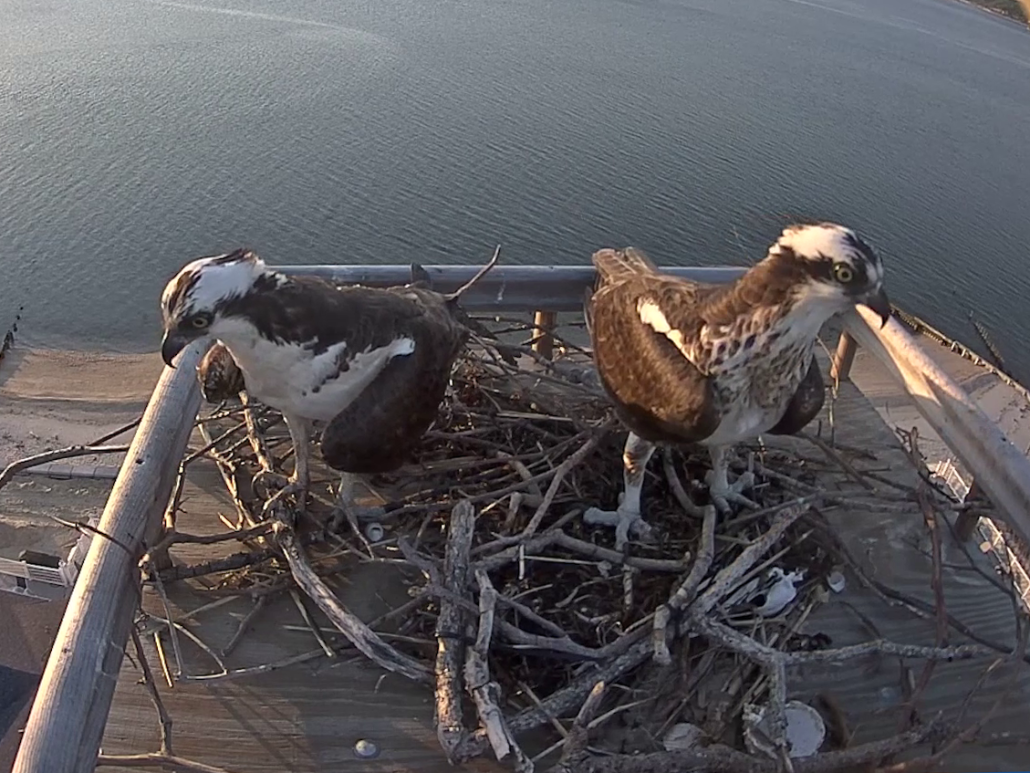 |
| GEORGE AND GRACIE |
This pair of ospreys, whom Tommy named George and Gracie, reside on the North Fork of Long Island during the summer. They were first spotted in 2014, perching on top of an old television tower located on Tommy’s property. Tommy had a wooden platform installed on the top to encourage the pair to build a nest, and sure enough, it worked. He also set up a video camera to be able to get a unique, up-close view of the birds in their nest.
Subscribe to:
Posts (Atom)